Boho Bedroom Plants: Styling Greenery as Decor
How to place plants in a boho bedroom as shapes and color: a tall corner anchor, a trailing plant, a group of three, pots that fit the palette, and what to do with corners that get no light.
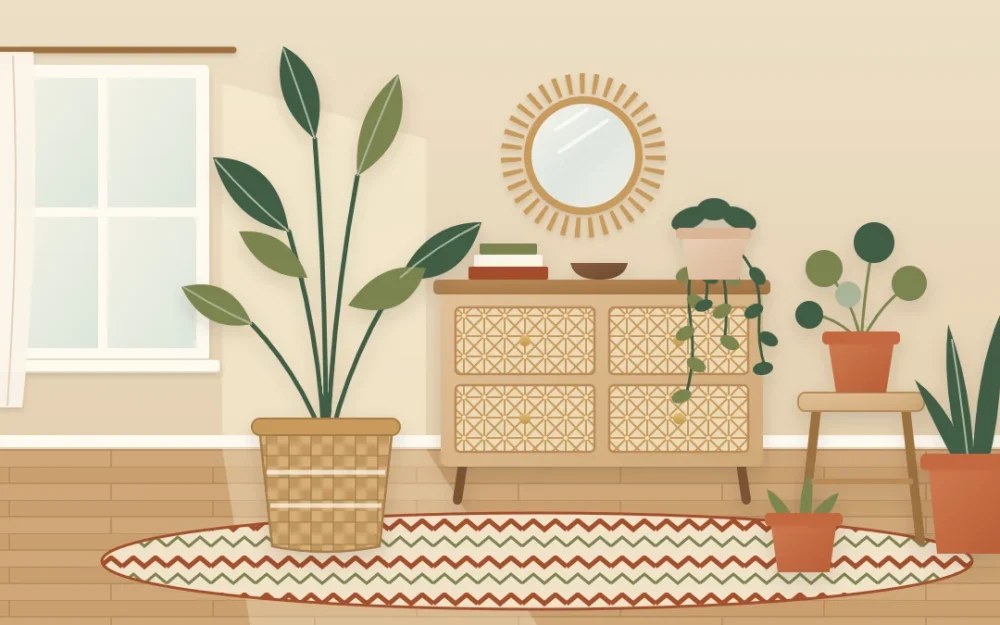
Greenery does a lot of quiet work in a boho room. Leaves soften straight furniture lines, add a color that sits easily beside clay and cream, and make a styled space look lived in. The trick with boho bedroom plants is to treat each one as a shape you are placing, the same way you would place a lamp or a basket.
That way of thinking keeps the room lush without tipping it into a jungle. A handful of well-placed plants reads as intentional; a dozen small pots scattered over every surface reads as clutter. Start with the light, then add plants one role at a time.
Start with the light the spot really gets
Light is the practical limit on every plant idea. Stand where the pot would go around midday and look toward the window. A plant a few steps into the room receives far less light than one beside the glass, even when the room feels bright to you.
Match the plant to the spot instead of forcing a plant you fell for into the wrong corner. As a loose guide:
- Bright, beside a window but out of harsh midday sun: rubber plants, fiddle-leaf figs and most large-leaved floor plants.
- Medium light, a little way into the room: pothos, heartleaf philodendron and other easygoing trailers.
- Lower light: snake plants and ZZ plants tolerate it better than most, though they grow slowly there.
- Almost no daylight: no living plant stays good-looking for long. Use artificial or dried stems instead.
Read the care label on anything you buy, and expect to move a plant once or twice before it settles. A plant that leans, drops leaves or stretches toward the window is telling you the spot is too dim.
Anchor one corner with a tall floor plant
One large plant does more for the room than five small ones. A floor plant that reaches somewhere between the top of the dresser and the top of the door frame fills an empty corner, balances the height of the bed wall and gives the eye a clear green shape to land on.
Put it in the corner nearest the window, on the opposite side of the room from your tallest piece of furniture if you can, so the height is spread out. Leave a little air around it: a hand-width gap of roughly 6 in (15 cm) between the leaves and the wall or curtain keeps the outline readable.
Let one plant trail from a dresser or shelf
A trailing plant adds a line that moves downward, which is useful in a room full of horizontal surfaces. Set the pot toward one end of a dresser or on the end of a shelf and let the stems fall over the edge rather than across the top.
Keep the rest of that surface calm so the trailing shape stays the feature; the guide to arranging bedroom shelves with natural pieces shows how to build around it. If you would rather lift the greenery right off the furniture, the ideas for trailing plants displayed at height cover the options. Anything fixed to a wall or ceiling needs hardware chosen for the wall type and the full weight of pot, plant and wet soil, used as the manufacturer directs.
Group three plants at different heights
Small plants look stronger together. Collect three and vary them on purpose:
- Height: one on the floor, one on a low stool, one on a taller stand or the dresser beside them.
- Leaf shape: one upright and spiky, one round and full, one trailing.
- Pot: related, not identical. Two terracotta pots and one woven cover, for example.
Stand them close enough that the leaves nearly touch. A gap wider than the pots themselves turns a group back into three separate objects.
Use a stool as a plant stand
A plain wooden stool is one of the most useful boho props. It lifts a medium plant to the height where it can be seen over the bed, adds a wood tone to the corner and costs you no wall space. A low stool beside the bed can hold a small plant as a living bedside piece.
Choose a stool that sits flat and steady, and place it out of the path you walk in the dark. Always use a saucer under the pot so water does not sit on the wood.
Make pots and baskets part of the palette
The container is as visible as the plant, so choose it the way you choose pillows. Unglazed terracotta and clay echo the warm tones in the bedding. Matte ceramic in cream or sand disappears quietly. Woven seagrass or jute baskets add texture and hide a plain plastic pot.
Limit yourself to two or three container types and repeat each at least twice around the room. A terracotta pot by the window and another on the dresser link those two areas without any extra decor.
Tip
Keep the plant in its plastic grower pot with drainage holes and drop it into the basket or decorative pot on a saucer. Lift it out to water at the sink, let it drain, then put it back. Baskets and floors stay dry.
Fill dark corners honestly
A corner far from the window is the wrong place for a living plant, however good it would look there. Good-quality artificial stems in a clay vase or a believable artificial floor plant in a basket give you the shape without the slow decline. Pick ones with matte leaves and some variation in color; dust them now and then.
Dried stems are the other option, and they suit the style especially well. See the guide to dried flowers and grasses for stems, vases and placement.
Know when to stop
As a rule of thumb, an average bedroom looks full with one tall plant, one trailing plant and one group of three. Add more only if each new plant has a clear job: a height to fill, a line to soften, a color to repeat.
Do the doorway check. Stand at the door and count the green shapes you can see in one glance. If they blur into a general leafiness, take one away and look again.
Good to know
Plants here are decor, and some common houseplants can be harmful if chewed. If pets or small children use the room, check each plant with a veterinary or poison-control source before bringing it home, and keep pots out of reach.
Frequently asked questions
How many plants should a boho bedroom have?
There is no fixed number. A common starting point for an average bedroom is one tall floor plant, one trailing plant and one small group of three. Add more only when a new plant fills a clear gap, and remove one if the greenery starts to blur together from the doorway.
Which plants work in a bedroom with little light?
Snake plants and ZZ plants tolerate lower light better than most, although they grow slowly in it. Pothos and heartleaf philodendron cope with medium light. For a corner with almost no daylight, artificial or dried stems are the realistic choice, because a living plant will gradually decline there.
What pots look best in a boho bedroom?
Unglazed terracotta and clay, matte ceramic in cream or sand, and woven baskets in seagrass or jute all suit the style. Choose two or three container types and repeat each around the room. Keep the plant in a draining grower pot inside the decorative one, with a saucer underneath.