Boho Bedroom Wall Art: Choosing and Arranging Prints
A six-step method for framed prints in a boho bedroom: which subjects and frames suit the style, four arrangements to choose from, and how to rehearse the layout with paper templates first.
At a glance
- Difficulty
- Easy
- Time
- About 1 to 2 hours, plus a day to live with the paper templates
- Best for
- A plain wall above a dresser or beside the bed
- Renter note
- Leaning prints need no fixings; hung frames need hardware chosen for your wall type, so ask before making holes
What you need
- Framed prints
- Brown paper or newspaper
- Scissors and a pencil
- Painter's tape
- Tape measure
- Level
- Hanging hardware suited to your wall type
Framed prints are one of the quickest ways to give a bedroom wall a point of view, and one of the easiest things to get slightly wrong: frames too small, hung too high, spaced unevenly. Good boho bedroom wall art looks relaxed, but that ease comes from a few quiet decisions made before anything goes on the wall.
The six steps below take you from choosing subjects to the final placement. Work through them in order, and rehearse the arrangement with paper before you commit to a single fixing.
Step 1: Pick subjects that share a mood
The bed already carries most of the pattern and texture in a boho room, so the prints can be simpler and calmer than you might expect. Subjects that sit well with the style:
- Abstract arches, suns and stacked shapes in flat blocks of warm color.
- Botanical line shapes: one leaf, one stem or a seed head, drawn loosely.
- Landscapes reduced to bands: hills, dunes or a horizon in earth tones.
- Textile fragments in frames: a piece of woven cloth, a block-printed remnant or a scrap of stitched fabric behind a mat.
Keep to two subject types on one wall. Three arches read as a set. An arch, a leaf, a landscape and a textile together read as a jumble unless color ties them firmly to each other.
Step 2: Hold the color to your palette
Pull the print colors from what is already in the room. Choose two or three tones from your earth-tone bedroom palette and let each one appear in at least two prints. A shared cream or sand background does a lot of the joining work, even when the shapes differ.
If you love a print with one color that is not in the room, repeat that color once somewhere else, on a pillow or a vase, so it looks chosen rather than accidental.
Step 3: Choose the frames
Three frame types cover almost every boho bedroom:
- Wood, pale, mid-brown or dark: warm and forgiving, and the safest choice for a group.
- Rattan or cane-wrapped: adds texture of its own, so it works best on one piece, not five.
- Thin black: a crisp outline that suits a cleaner, more modern room and sharpens pale prints.
Mix two frame finishes at most, and repeat each one. Wide off-white mats give small prints more presence and leave the wall some breathing room. A textile fragment can skip the frame entirely and sit between two slim wooden bars.
Tip
Frames glazed with acrylic instead of glass are lighter and easier to handle, which makes them a sensible choice for a bedroom, especially anywhere near the bed.
Step 4: Decide on an arrangement
Four arrangements suit the style, and each sets a different tone:
- One large piece. The calmest option. It needs to be generous: spanning roughly two-thirds of the width of the furniture below it is a common starting point.
- A pair. Two equal frames side by side feel ordered and restful, good over a dresser or in a room that already has plenty of pattern.
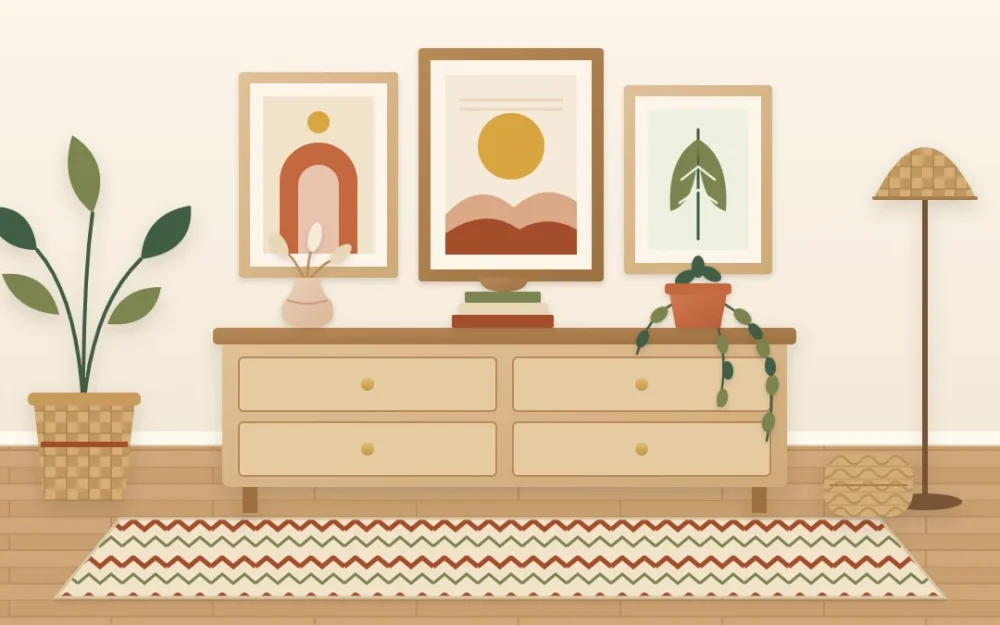
- A loose trio. Three frames in two or three sizes, lined up along their center line or their bottom edge. Relaxed, but still clearly a group.
- Leaning prints. Frames propped on a dresser or a picture ledge, overlapping slightly. The most casual look, and the easiest to change.
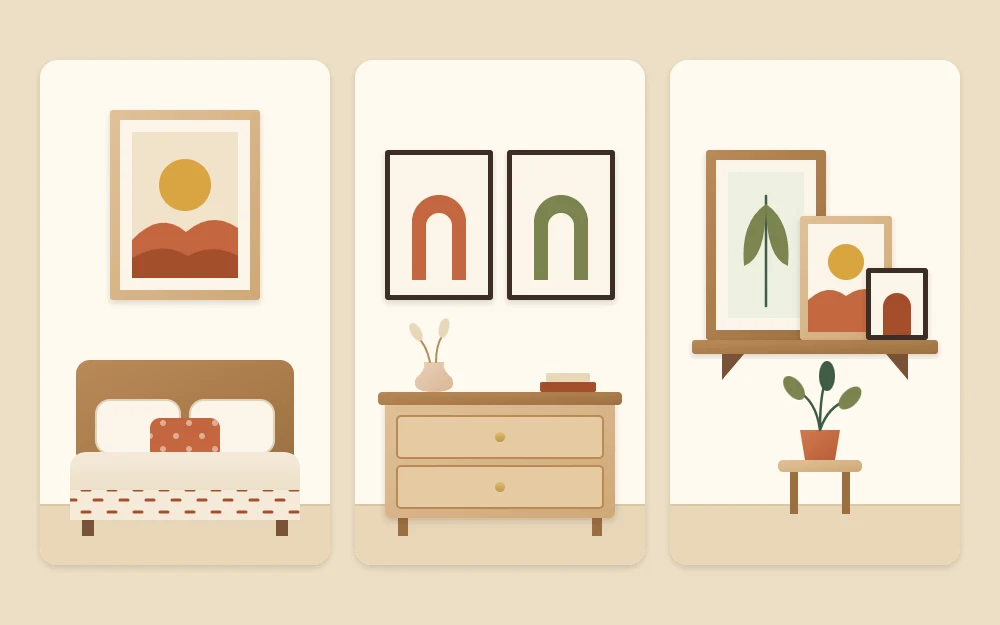
Treat the whole group as one shape. Its outer edges should relate to the bed or dresser beneath it, not drift off to one side.
Step 5: Rehearse with paper templates
Paper costs nothing to move. A rehearsal on the wall shows problems that are invisible on the floor.
- Trace each frame onto brown paper or newspaper and cut it out. Mark where the hanging point on the back of the frame falls.
- Stick the templates to the wall with small pieces of painter’s tape, pressed on lightly.
- Set the height. On an open wall, the center of the arrangement at around eye level, about 57 to 60 in (145 to 152 cm) from the floor, is a common starting point. Above furniture, a gap of roughly 6 to 10 in (15 to 25 cm) between the furniture top and the bottom of the frames usually reads as connected.
- Even out the gaps. Roughly 2 to 3 in (5 to 8 cm) between frames is a good rule of thumb; whatever you choose, keep it the same throughout.
- Step back to the doorway, then leave the templates up for a day and adjust.
Paint finishes and surfaces vary, so test the tape in a hidden spot first, follow the manufacturer instructions and peel it away slowly.
Step 6: Put the prints up
Once the paper arrangement looks right, mark each hanging point through its template, take the paper down and fix the frames one at a time, checking each with a level.
Before you hang anything
Choose hardware to suit your wall type and the weight of each framed piece, and follow the manufacturer instructions for both the hardware and the frame. If you are unsure about the wall, or a piece is large, get help or lean it on furniture instead. Keep heavy framed pieces off the wall directly above the pillows. In a rental, check your lease or ask before making holes.
If the wall still looks off
- It looks scattered. The gaps are too wide. Pull the frames closer until they read as one group.
- It looks lost. The prints are too small for the wall. Add wider mats or trade three small pieces for one large one.
- It looks stiff. Everything matches. Swap one frame finish, or replace a print with a round mirror; these mirror shapes and placements show which kinds suit the style.
- It looks busy. Take one piece away and leave the space empty for a week.
Prints are only one way to finish a wall. If frames are not giving you the texture you wanted, compare them with the woven, basket and textile options in these boho wall decor ideas.
Frequently asked questions
How many prints should go on one bedroom wall?
One to three is enough for most bedroom walls. One large print is the calmest choice, a pair feels ordered and a trio feels relaxed. More than that starts to compete with the bed, which already carries most of the pattern and texture in a boho room. Leave at least one wall completely empty.
Do all the frames have to match?
No, but they should relate. Two frame finishes, each used more than once, usually looks collected and deliberate. A single odd frame among matching ones tends to look like a mistake. If your prints differ a lot in subject and color, matching frames and mats will help pull them together into one group.
Can I put framed art above the bed?
You can, but keep it light. Avoid heavy framed or glass-fronted pieces directly above the pillows. A small frame with acrylic glazing, an unframed textile or a print leaning on a nearby dresser are gentler options. Whatever you fix to the wall, choose hardware for the wall type and the weight of the piece.