Mixing Patterns in a Boho Bedroom: A Simple Scale Formula
A repeatable formula for combining patterns on the bed and floor: one large, one medium and one small pattern in shared colors, with solids between them and a floor test before you buy more.
At a glance
- Difficulty
- Easy
- Time
- About 30 to 45 minutes
- Best for
- Beds and rugs where several patterns meet and currently clash
- Renter note
- No fixings needed: everything here is textiles you can move
What you need
- The patterned pillows, quilts and throws you already own
- Plain sheets or a plain duvet cover
- One or two solid pillow covers
- A clear patch of floor or a made bed
- A phone camera for comparing options
You buy a striped pillow you love, then a patterned quilt you love, then a rug you love, and together they look like an argument. Mixing patterns is the part of boho style that people find hardest, mostly because it seems to depend on a talent you either have or do not.
It depends on scale. Patterns clash when they are the same size and fight for the same attention. Give each one a different size and a shared set of colors, and nearly any combination settles down. Here is the formula, followed by a worked example for the bed.
The formula: large, medium, small, plus solids
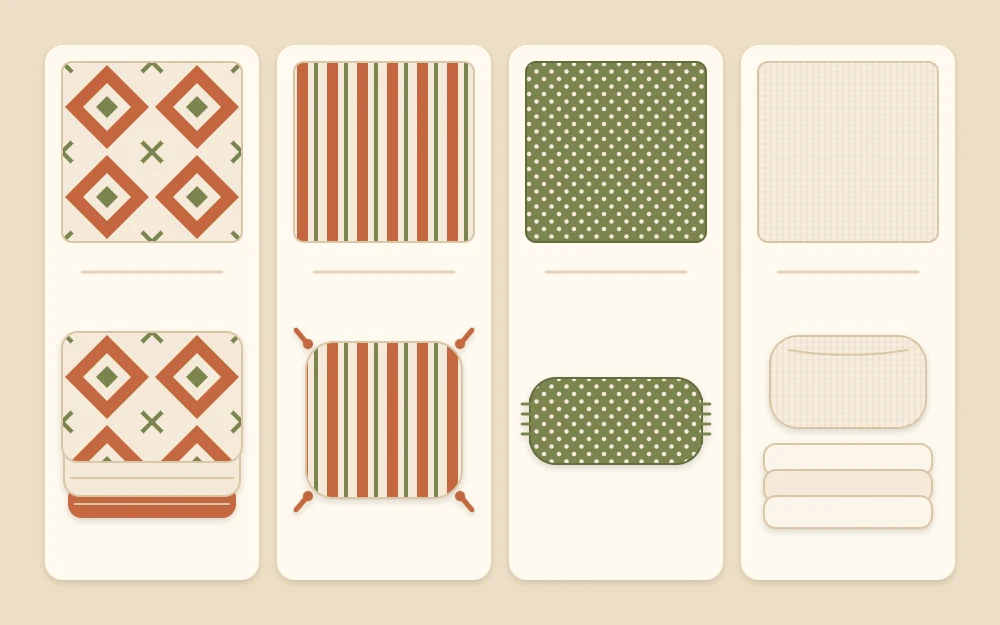
Scale means the size of the repeating shape. A diamond as wide as your hand is large-scale; a stripe about two fingers wide is medium; a dot the size of a pea is small. The formula uses one of each:
- One large-scale pattern that leads. You can read it from across the room.
- One medium-scale pattern that supports it.
- One small-scale pattern that reads almost as a texture from a distance.
- Solids in between, to rest the eye.
All of them share the same two or three colors. Three patterns is a comfortable number for a bedroom. Two is fine, and four is possible if the fourth is very quiet, but beyond that it becomes hard to give each one room.
Step 1: Fix two or three colors first
Color is what makes different patterns look related, so settle it before anything else. Pick two or three colors, such as terracotta, cream and olive, and hold every pattern to them. A pattern does not need all three, but it should not bring in a new one.
If you already own a patterned piece you want to keep, take your colors from it. If you want a brighter scheme than earth tones, the same rule applies; the guide to a bolder, more colorful palette shows how to keep saturated color in check.
Step 2: Choose three different pattern types
Scale separates patterns by size. Type separates them by character, and using three different types keeps them from blurring into each other. The main families are:
- Stripes: the most orderly, and the easiest partner for anything.
- Geometrics: diamonds, lattices, zigzags, checks.
- Organic patterns: florals, leaves, loose brush marks, wavy lines.
- Dots and small repeats: specks, dashes, tiny crosses.
A dependable trio is one geometric, one stripe and one organic or dotted pattern. Two geometrics of similar size are the most common cause of a clash, because their lines compete. If you want two, make one much larger than the other.
Step 3: Put each scale where it fits
Large patterns need large surfaces, or the repeat gets cut off before you can read it. Small patterns suit small objects, where a large one would show only a fragment.
- Large scale goes on the rug or the quilt. Choose one of the two, not both. If the rug carries a bold pattern, keep the quilt plain or very quiet, and the other way around.
- Medium scale goes on the larger pillows or on a throw folded at the foot of the bed.
- Small scale goes on a lumbar pillow, a small accent pillow or a narrow trim.
- Solids go on the biggest remaining surfaces: sheets, the duvet cover, the walls, the curtains.
The rug is the largest patterned surface in most bedrooms, so it sets the terms for everything above it. For rug types and placement, see the guide to choosing a boho bedroom rug.
Step 4: Space the patterns apart
Two patterns touching each other merge into one busy area. A solid between them lets each be seen. On the bed, alternate: patterned quilt, plain sheet fold, striped pillows, plain pillows behind. In the room, keep the patterned rug away from a patterned curtain by leaving plain wall and plain bedding between them.
Tip
Texture counts as a quiet pattern. A tufted, waffle or chunky knit piece in a solid color adds interest without adding another print, so use it where a fourth pattern would be too much.
Step 5: Run the floor test
Before you buy anything more, test what you have. Patterns behave differently together than they do alone, and the only reliable check is to see them side by side.
- Lay every patterned piece you are considering on the floor or the bed, overlapping the way they would in use.
- Add the solids between them.
- Step back to the doorway, or as far away as the room allows, and squint.
- Ask three questions. Can you tell which pattern leads? Can you still read each one separately? Does any color appear that is not in your set?
- Remove the piece that fails, and look again. Only then decide what, if anything, is missing.
If you are shopping for a new piece, take a photo of the group on your phone or bring a pillow cover with you. Judging scale from memory is unreliable.
A worked example for the bed
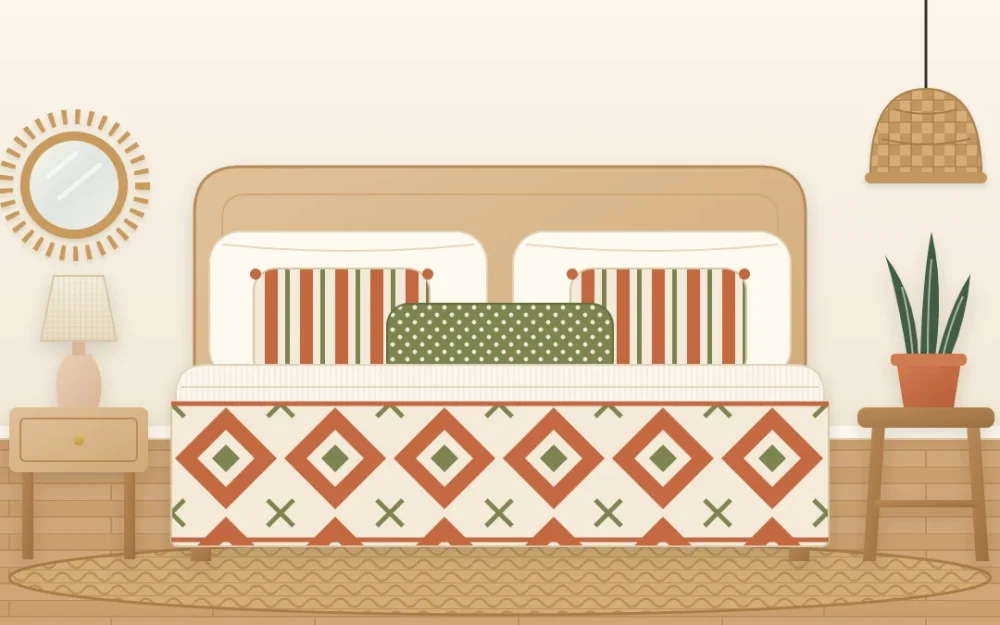
Take terracotta, cream and olive as the colors and build from the bottom layer up.
- Base: plain cream sheets and pillowcases. These are the solids.
- Large: a quilt with a diamond pattern in terracotta on cream, each diamond roughly a hand-width across.
- Medium: two square pillows in an olive and cream stripe.
- Small: one lumbar pillow with small terracotta dots on cream.
- Texture: a solid olive throw with fringe, folded over one corner.
Each pattern has its own scale and its own type, every piece uses the same three colors, and cream separates them. On the floor, a plain jute rug or a rug with a very faint pattern would finish the room without competing with the quilt. To arrange the pillows themselves, the guide to mixing pillow sizes and textures goes through the order from back to front.
When it still clashes
If the mix looks wrong after all that, one of four things is usually the cause:
- Two patterns are the same scale. Replace one with a clearly larger or smaller version.
- A stray color has crept in. Find the piece carrying it and take it out.
- There are not enough solids. Swap one patterned pillow for a plain one.
- Both the rug and the quilt are bold. Turn the quilt over to a plain side or fold it at the foot, so only a strip shows.
Frequently asked questions
How many patterns can I mix in one bedroom?
Three is a comfortable number for most bedrooms: one large, one medium and one small. Two also works well. A fourth is possible if it is very quiet or close to a texture, but each added pattern needs more plain surface around it to stay readable.
Do patterns have to match in color?
They do not have to be identical, but they should share a limited set of two or three colors. Shared color is what makes a stripe, a geometric and a floral look like a group. Slightly lighter or deeper versions of the same color are fine and add depth.
Can I mix stripes with geometric and floral patterns?
Yes, and that mix is one of the easiest to get right, because the three types look different enough to stay separate. Give each a different scale, for example a large geometric, a medium stripe and a small floral, and keep all three within the same colors.