Boho Throw Pillows: How to Mix Sizes, Textures and Patterns
A simple formula for arranging pillows on a boho bed: three rows that step down in size, a mix of one pattern, one texture and one solid, and a loose guide to how many suit each bed size.
At a glance
- Difficulty
- Easy
- Time
- About 10 to 15 minutes
- Best for
- A bed where the pillows look random or excessive
- Renter note
- No fixings needed
What you need
- Sleeping pillows in plain cases
- Two large square pillows
- One or two smaller accent pillows
- One lumbar pillow
- A basket or bench for night-time storage
A pile of pillows that looks effortless on someone else’s bed can look like a spill on yours. The difference is rarely the pillows themselves. It is the order they sit in, how their sizes step down, and whether the mix has one clear idea behind it.
Boho throw pillows are meant to look collected, not matched, which makes them harder to arrange than a tidy set of four. A small formula takes care of it: build from the back in rows, step the sizes down, and limit the mix to one pattern, one texture and one solid.
Build from the back in three rows
Every arrangement that works has the same skeleton, whether it uses three decorative pillows or six.
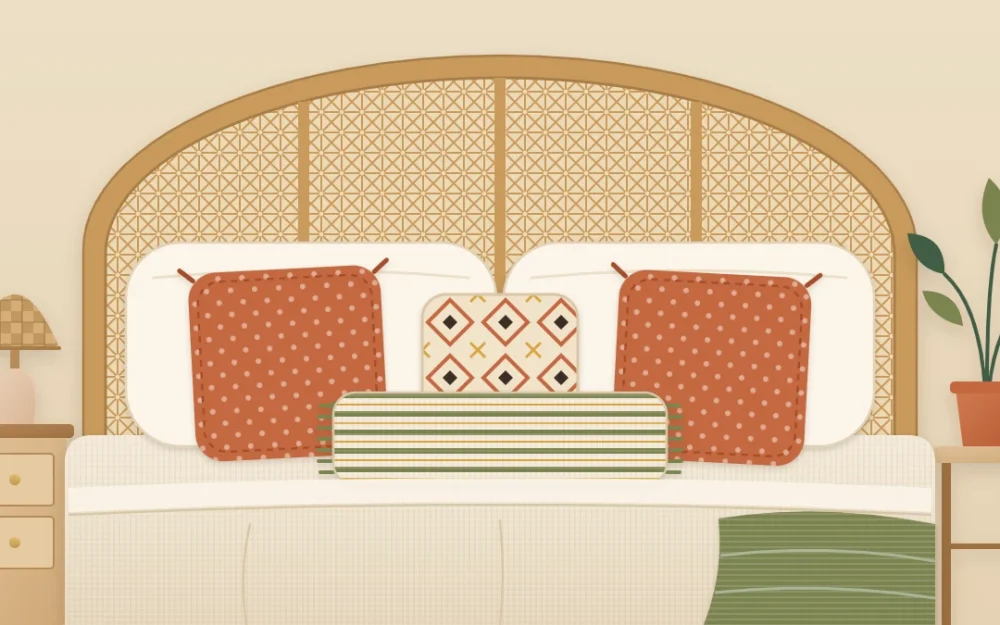
- Back row: sleeping pillows. Stand them upright against the headboard or stack them flat in pairs. In plain cases, they form a quiet backdrop.
- Middle row: larger squares. Two squares of about 22 to 24 in (55 to 60 cm) placed in front. These carry most of the color.
- Front row: accents. One or two smaller squares of roughly 18 in (45 cm), and a single long lumbar pillow at the very front, centered or pushed to one side.
Each row should be visibly shorter than the one behind it. When two rows are the same height, the front one hides the back one and the whole group turns into a wall of fabric.
Choose odd for relaxed, even for calm
The number of decorative pillows changes the mood more than the pillows do.
- An odd group of three or five sits off-center on purpose. It looks casual and suits a room with a lot of plain surfaces.
- A symmetrical set of two or four, mirrored left and right with a lumbar in the middle, feels ordered. Choose it when the rug, quilt or wall behind the bed is already busy.
- A minimal pair with one long lumbar is the least effort and still reads as finished.
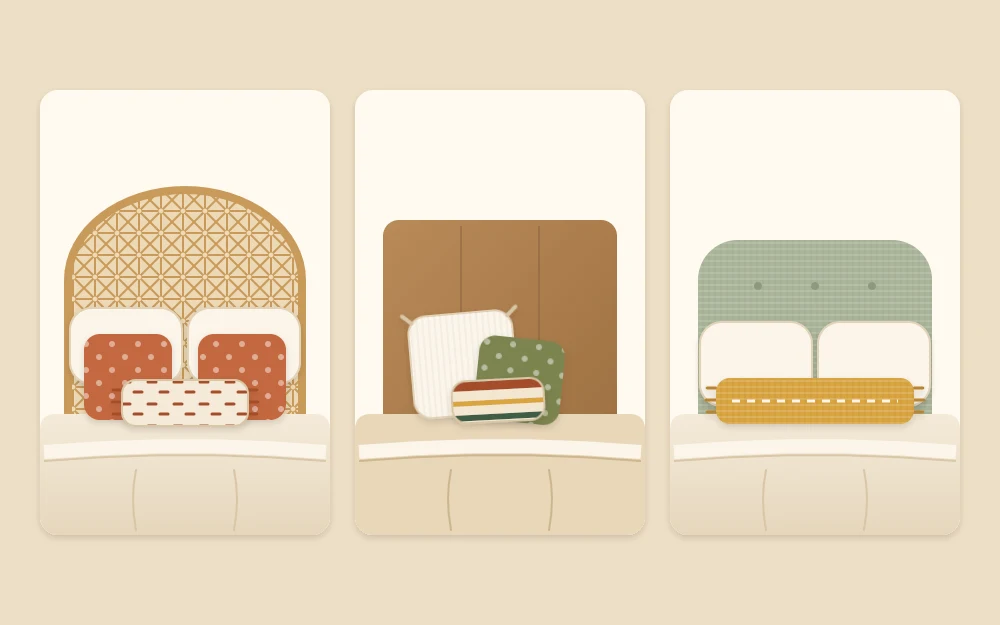
Mix one pattern, one texture and one solid
This is the part that makes the group look collected. Pick one pillow type from each of three families and repeat as needed:
- One pattern: a stripe, a diamond, a simple geometric or a loose botanical print.
- One texture: tufted, flat-woven, fringed, knotted or stitched with an embroidered-look design. Plain in color, interesting to touch.
- One solid: linen, cotton or velvet-look fabric in a single tone, to rest the eye.
Put the solids and textures in the larger sizes and keep the pattern for a smaller pillow or the lumbar. Pattern shrinks well; a large busy square tends to dominate. If you want two patterns on the bed, vary their scale as described in this formula for mixing patterns in a boho bedroom.
Tie the colors to something else in the room
Pillows look random when their colors appear nowhere else. Before you buy or pull one from the closet, find its color in the rug, the throw, a print on the wall or a pot on the dresser. Two matches in the room is a comfortable minimum.
Three tones are usually enough: the light base of the bedding, one earthy mid tone and one deeper accent. The simplest route is to take the pillow colors straight from the layers beneath them; the guide to layering boho bedding explains how to set that palette for the whole bed.
Tip
Use inserts one size larger than the covers, for example a 20 in (50 cm) insert in an 18 in cover. The pillow fills out to the corners and keeps its shape instead of slumping.
How many is enough
These counts are a loose guide for decorative pillows, not including the ones you sleep on. Go lower if you like a quiet bed.
| Bed size | Decorative pillows | An arrangement to try |
|---|---|---|
| Twin | One to two | One large square and a short lumbar |
| Full | Two to three | Two squares and one lumbar |
| Queen | Three to five | Two large squares, one or two accents, one lumbar |
| King | Four to six | Three large squares, two accents, one long lumbar |
A useful ceiling: if the pillows cover more than about the top third of the bed, there are too many.
Fix a pile that looks random
- Everything is the same size. Swap two pillows for larger squares and add one lumbar so the heights step down.
- Every pillow has a pattern. Replace half with solids or plain textures in colors taken from the patterns.
- The colors fight. Remove any pillow whose color is not repeated elsewhere in the room.
- It looks flat and thin. Fuller inserts and one chunky texture, tufted or fringed, add depth without adding numbers.
- It looks stiff. Turn one square on its point, or slide the lumbar off-center.
- There are simply too many. Take away the two you like least and live with the gap for a few days.
Where the pillows go at night
An arrangement only survives if taking it apart is easy. Give the decorative pillows a home within arm’s reach of the bed, so they do not end up on the floor:
- A large woven basket at the foot or the side of the bed.
- A bench or a chair, stacked largest first.
- The top of a blanket chest.
The basket can do double duty for the throw as well; these ways to drape, fold and store throw blankets include a rolled-in-a-basket option that pairs well with stacked pillows. If moving five pillows twice a day sounds tiresome, that is a good reason to choose the minimal pair and lumbar instead.
Frequently asked questions
How many throw pillows should go on a queen bed?
Three to five decorative pillows is a comfortable range for a queen, on top of the pillows you sleep on. Two large squares, one smaller accent and a lumbar is a reliable starting set. If the pillows cover more than roughly the top third of the bed, take one or two away.
Do boho pillows need to match each other?
They should relate without matching. Sharing two or three colors is what holds a mixed group together, while the fabrics and patterns can differ. A common mix is one patterned pillow, one textured pillow in a plain color and one smooth solid, repeated in different sizes across the bed.
What size inserts should I use for pillow covers?
Choosing an insert about 2 in larger than the cover is a common rule of thumb, because it fills the corners and gives the pillow a plump shape. Very thick or stiff covers may suit an insert of the same size instead. Feather-style and down-alternative inserts are easier to shape than firm foam.