Styling a Woven Wall Hanging Above the Bed
How to choose the size of a woven wall hanging for your bed, how high to place it, when to use one large piece or a trio, and what to consider before it goes on the wall.
At a glance
- Difficulty
- Easy
- Time
- About 30 to 60 minutes
- Best for
- Beds placed against a plain wall
- Renter note
- Needs a wall fixing: choose it for your wall type and ask before drilling
What you need
- Woven wall hanging on a rod
- Tape measure
- Pencil
- Paper cut to the size of the hanging
- Level
- Fixing chosen for your wall type and the weight of the piece
A woven wall hanging is the piece most people picture when they think of a boho bedroom: soft cotton or wool on a wooden rod, rows of knots, a line of fringe. It warms a plain wall without adding color or hard edges, which is why the space above the bed suits it so well.
Whether it looks right there comes down to a few measurements. Too small and it floats; too high and it loses its link to the bed; too low and the fringe ends up in the pillows. The steps below take you from choosing a size to getting it on the wall.
Step 1: Choose a size that fits the bed
Measure the width of your bed, or of the headboard if it is wider than the mattress. As a starting point, look for a hanging that is roughly half to two-thirds of that width. On a bed about 60 in (152 cm) wide, that suggests a piece somewhere around 30 to 40 in (76 to 102 cm) across.
These are rules of thumb, not requirements. A narrower piece can work if it is long and dramatic, and a hanging nearly as wide as the bed can stand in for a headboard. What rarely works is a small piece alone on a wide wall.
Step 2: Set the height
The bottom of the fringe should sit a little above the headboard, or above the tops of the pillows if there is no headboard. A hand-width gap of roughly 6 to 10 in (15 to 25 cm) is a common starting point. It is close enough that the bed and the hanging read as one composition and far enough that the fringe hangs free.
- Make the bed with the pillows you normally use, propped the way you keep them by day.
- Sit up in bed and lean back. Note how high your head and shoulders reach, and plan for the fringe to stay above that line.
- Mark the planned bottom edge lightly in pencil, then measure up by the full length of the hanging to find where the rod will sit.
- Step back to the doorway and check that the top of the piece does not crowd the ceiling.
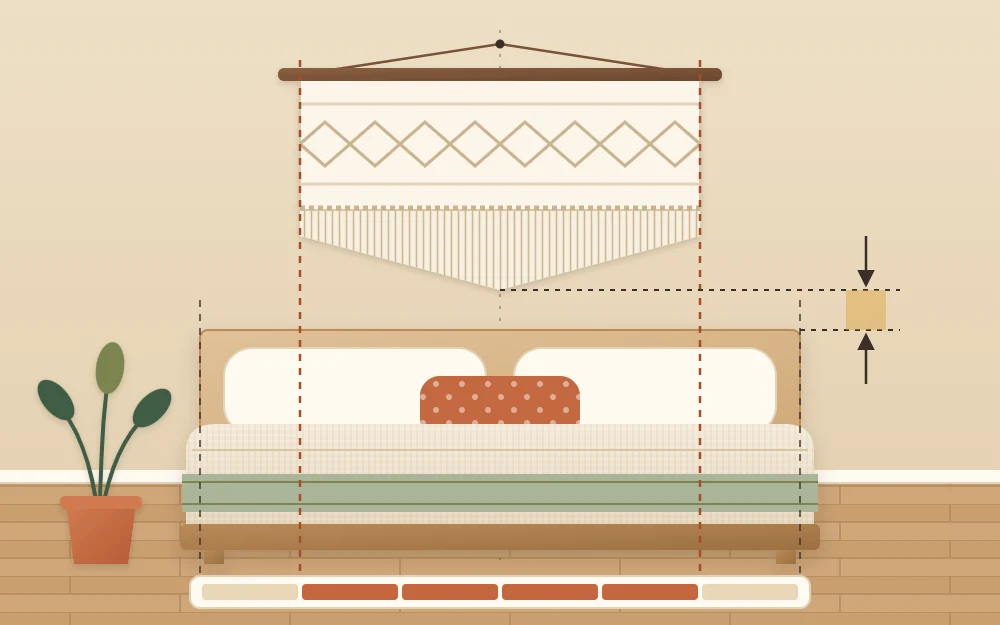
The headboard changes the sums. A tall or ornate one leaves less wall and competes for attention, so a smaller, simpler hanging suits it. A low or plain one gives a large hanging room to lead. The guide to boho headboard options covers how each type affects the wall above it.
Step 3: Decide on one large piece or a staggered trio
One large hanging is the calmer choice. It gives the bed wall a single focal point and suits rooms where the bedding is already patterned.
A trio of smaller hangings works when you own small pieces or want a lighter, more playful look. Treat the three as one shape:
- Keep the whole group within the same half to two-thirds of the bed width.
- Stagger the heights slightly, with the middle piece highest or lowest.
- Leave narrow, even gaps between them, about 2 to 4 in (5 to 10 cm), so they read as a set.
- Choose pieces that share a fiber or a color, even if their shapes differ.
Step 4: Center it on the bed, not the wall
If the bed sits in the middle of the wall, the two centers are the same. Often they are not, because a window, a door or a closet pushes the bed to one side. In that case, center the hanging on the bed. The two are seen together, and a piece centered on the wall but off-center to the bed looks like a mistake.
Find the midpoint of the headboard, mark it lightly in pencil on the wall, and measure out from there. Before fixing anything, cut a paper template the size of the hanging and hold it in place, or ask someone to hold the piece while you look from the doorway.
Step 5: Choose color and fiber for the room
Most woven hangings are cream or natural white, and that is a good default: the interest comes from the knots and the shadows they cast, so the piece adds texture without adding to the color count. On a white wall, pick a warm cream or oatmeal so it does not disappear. On a clay or sand wall, pale fiber stands out well.
Fiber changes the character. Thick cotton rope with large knots, the macramé look, is bold and graphic. Woven wool with tufts and loops is softer and denser. A hanging with one or two colored bands is a simple way to repeat a color from the bedding.
Step 6: Keep the wall around it quiet
A woven piece has a lot of detail, and it needs plain wall on each side to show it. Leave the rest of the bed wall empty, or limit it to low items on the bedside tables. Framed prints, baskets and a hanging on the same wall will compete; for other walls in the room, the guide to boho wall decor ideas has options that pair well.
Soft, natural companions work best nearby: a plant at one side of the bed, or a vase of grasses on the bedside table. The guide to decorating with dried flowers and grasses shows how to keep those arrangements in proportion.
Step 7: Hang it for its weight and your wall
Woven hangings vary more in weight than they look. A small cotton piece on a thin dowel is very light. A large one with dense wool, thick rope and a solid branch or rod can be surprisingly heavy, and it hangs from only one or two points.
Before you hang anything
Choose the fixing for your wall type and for the weight of the piece, rod included, and follow the manufacturer instructions for the hardware you use. If you do not know what the wall is made of, find out first. For a large or heavy hanging, get help if you are unsure, or place it on a wall that is not above the bed.
Above the pillows, lighter is better. Pick a piece with a slim, light rod for this spot and save a hanging on a thick branch for another wall. Once it is up, check that the rod sits level and comb the fringe straight with your fingers.
Frequently asked questions
How wide should a wall hanging above a bed be?
A common starting point is roughly half to two-thirds of the width of the bed or headboard. That is wide enough to look connected to the bed without running edge to edge. A group of smaller hangings can fill the same span if you treat the group as one shape.
How high should I place a wall hanging over the bed?
Start with the bottom of the fringe about 6 to 10 inches above the headboard, or above the pillows if you have no headboard. Then sit up in bed and check that it stays clear of your head and shoulders. Raise it a little if you tend to lean against the wall.
Can a woven wall hanging replace a headboard?
Visually, yes. A hanging close to the width of the bed gives the wall a clear focal point and frames the pillows much as a headboard would. It will not give you anything to lean against, so add a couple of large, firm pillows if you like to sit up in bed.