Boho Bedroom Rugs: Choosing, Placing and Layering Them
Four rug types that suit a boho bedroom, three ways to place a rug around the bed, how to layer a patterned rug over jute, and a simple tape test for getting the size right.
At a glance
- Difficulty
- Easy
- Time
- About 20 to 30 minutes to tape and test a size
- Best for
- Bedrooms where the rug sits partly under the bed
- Renter note
- No fixings needed; test painter's tape on a hidden patch of floor first
What you need
- Tape measure
- Painter's tape
- Large base rug such as braided jute
- Smaller patterned flat-woven rug
- Non-slip rug pad suited to your floor
The rug is the largest pattern in most bedrooms, and the first thing bare feet meet in the morning. Get it right and the bed looks anchored and the whole room warmer. Get the size wrong and even a beautiful rug looks like a bath mat lost in the middle of the floor.
Choosing boho bedroom rugs comes down to three decisions: which type suits your room, where it sits in relation to the bed, and whether to layer two together. This guide takes them in that order, with a tape test to run before you commit.
Four rug types that suit the style
Most rugs that read as boho fall into one of four families. Each brings something different, so decide what the room is missing: pattern, softness or texture.
| Rug type | What it looks like | What it adds | Best used |
|---|---|---|---|
| Flat-woven geometric | Thin, no pile, with diamonds, stripes or zigzags | Strong pattern and color | Under the bed or layered on top of a plain rug |
| Shaggy cream with a dark lattice | Deep, soft pile with a simple diamond grid | Softness and a quiet pattern | Where your feet land, in calmer or neutral rooms |
| Braided or woven jute | Thick natural fiber in tan and straw tones | Texture and a warm neutral base | As a large base layer under a smaller rug |
| Faded traditional-style pattern | Low pile with a worn-looking medallion or border | Soft, muted color and a collected feel | As the one patterned piece in a plain room |
Jute and similar plant fibers are firm underfoot rather than plush, which is one reason they are so often used underneath something softer. The guide to natural textures such as rattan, jute and linen covers how these fibers combine with the rest of the room.
Three placements around the bed
A rug should relate to the bed, not float beside it. These three layouts cover most rooms.
One large rug under the lower two-thirds
Slide the rug under the bed from the foot end and stop it short of the bedside tables, so the tables stand on the floor and the rug begins just in front of them. As a common starting point, aim for roughly 18 to 24 in (45 to 60 cm) of rug showing on each side and at the foot, so you step onto it when you get up.
A runner on each side
Two matching or related runners, one along each side of the bed, give you softness where you stand and leave the center of the floor clear. Choose runners a little shorter than the bed and roughly 24 to 30 in (60 to 75 cm) wide as a rule of thumb. With a bed pushed against a wall, use one.
A small rug at the foot
A single small rug set across the foot of the bed, a little narrower or wider than the bed itself, suits rooms where the sides are tight. It also works as a second, decorative rug in a larger room.
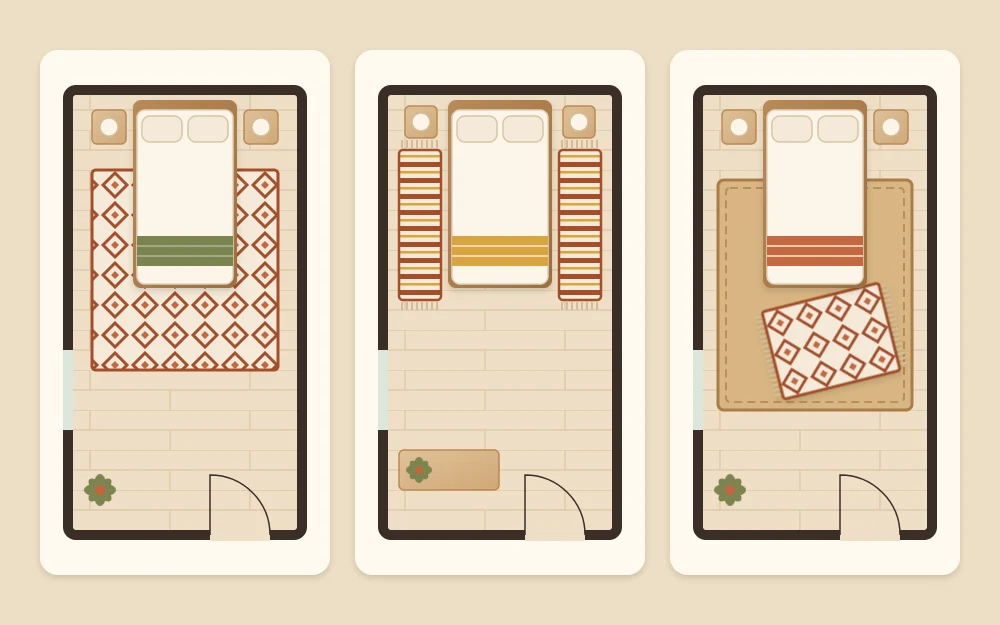
If floor space is limited, a rug under only the lower half of the bed often does the job; the ideas for layering a small boho bedroom without crowding it go further.
Test the size with painter’s tape
Rugs are hard to judge from numbers alone. Marking the outline on the floor takes a few minutes and settles most doubts.
- Measure the bed and note the rug size you are considering.
- Mark the four corners of that size on the floor with short strips of painter’s tape, then join them with tape if you want the full outline.
- Check that the door, closet doors and drawers open without catching the marked area.
- Stand where you get out of bed. Your feet should land inside the outline, not half on and half off the edge.
- Look from the doorway. The outline should extend clearly past the sides of the bed.
- Adjust the tape for the next size up or down and compare before you decide.
Tip
Floor finishes vary, so press a short test strip of tape in a hidden spot first, follow the tape manufacturer’s instructions and lift it the same day rather than leaving the outline down for a week.
Layering a patterned rug over jute
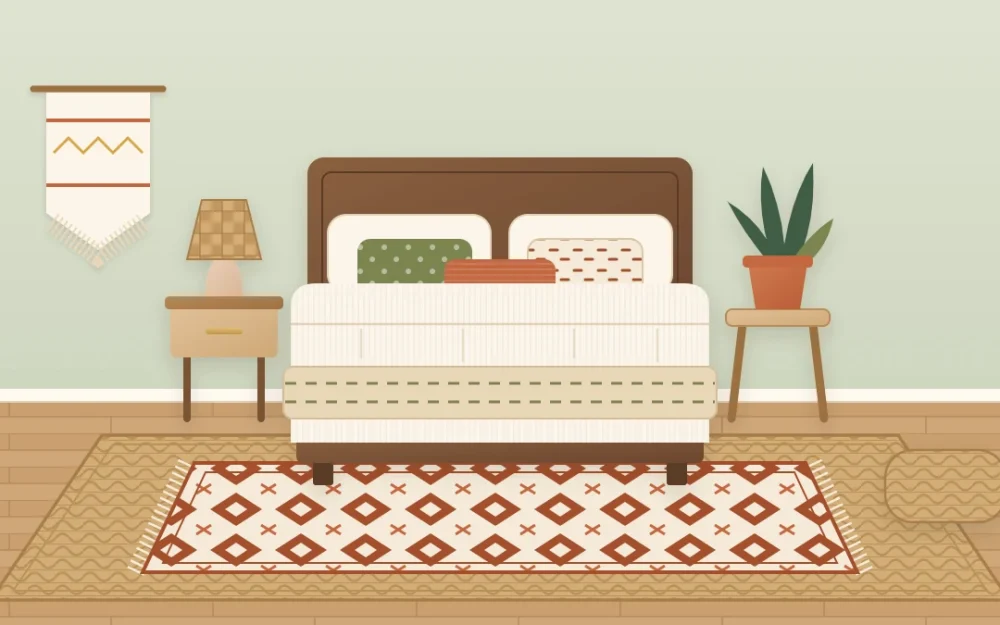
Layering is a very boho move, and it solves a real problem: the patterned rug you love is often too small on its own. Put a large, plain jute rug down as the base in the under-the-bed position, then lay the smaller patterned rug on top.
- Leave a clear border. Roughly 8 to 12 in (20 to 30 cm) of the base rug showing around the top one reads as deliberate.
- Thin over thick. A flat-woven rug sits well on jute. Two thick piles stacked together feel unstable and look heavy.
- Straight or angled. Line the top rug up with the bed for a calm look, or turn it slightly at the foot for a relaxed one.
- One pattern only. Keep the base plain so the top rug stays the feature.
Set the pattern scale against the bedding
The rug and the bed are seen together, so they need to differ in scale. If the quilt carries a large, bold pattern, choose a rug with a smaller, quieter one, or a textured plain rug. If the bedding is mostly solid, the rug can take the large pattern.
Share colors rather than matching exactly. A rug that picks up two tones from the pillows or throw ties the floor to the bed without looking like a set. The scale formula for mixing patterns explains how to combine large, medium and small patterns across the room.
Consider the floor as well. A pale rug on a pale floor needs a border, fringe or strong texture to define its edge, while a dark floor shows off cream and sand tones.
Add a rug pad that suits your floor
Flat-woven rugs and runners slide and wrinkle on smooth floors, and a layered top rug can creep across the one beneath. A non-slip rug pad cut slightly smaller than the rug keeps it flat and in place, and adds a little cushion under thin weaves.
Pads are made for different surfaces, so pick one described as suitable for your floor type and follow the manufacturer’s guidance. Make sure corners lie flat, especially beside the bed, where you walk in low light.
Frequently asked questions
How big should a rug be under a bed?
There is no single correct size. A common starting point is a rug wide enough to show roughly 18 to 24 inches on each side of the bed and at the foot, so your feet land on it. Mark the outline with painter's tape to check it against doors and drawers.
Should the rug go under the whole bed?
It does not have to. Placing the rug under the lower two-thirds of the bed, starting just in front of the bedside tables, shows more of the rug where you can see and feel it. Runners at the sides or a small rug at the foot are good alternatives.
Can you layer two rugs in a bedroom?
Yes. Use a large, plain, natural-fiber rug as the base and a smaller, thinner patterned rug on top, leaving a border of the base visible all around. Keep to one pattern, avoid stacking two thick piles, and use a non-slip pad so the top rug stays put.