Wood Accents in a Boho Bedroom: Mixing Tones and Finishes
Wood tones do not have to match. Learn how to pick a dominant tone, read undertones, repeat each wood around the room and fix the most common mixed-wood problems.
A honey-colored bed frame, a dark dresser handed down from a relative, a pale stool picked up secondhand: most bedrooms collect wood this way, one piece at a time. The question that follows is whether those tones have to match before the room can look pulled together.
They do not. In a boho bedroom, mixed wood accents are an advantage, because the style is meant to look gathered over time. What separates a collected room from a mismatched one is a handful of small decisions, and most of them cost nothing but a little rearranging.
Why mixed wood looks right in a boho room
A matching bedroom set gives one tone, one finish and one shape repeated across the room. It is tidy, but it flattens the warmth that makes boho appealing. Different woods bring different grain, depth and age, and together they suggest a room that grew instead of arriving in one delivery.
The catch is intent. Two tones that are almost the same look like a failed attempt to match. Two tones that are clearly different, each used more than once, look like a choice. Most problems with mixed wood come down to that difference, and the fixes below follow from it.
Choose one dominant tone
Look at the wood already in the room and find the tone that covers the most surface. It is usually the bed frame, the dresser or the floor. That is your dominant tone, and it stays.
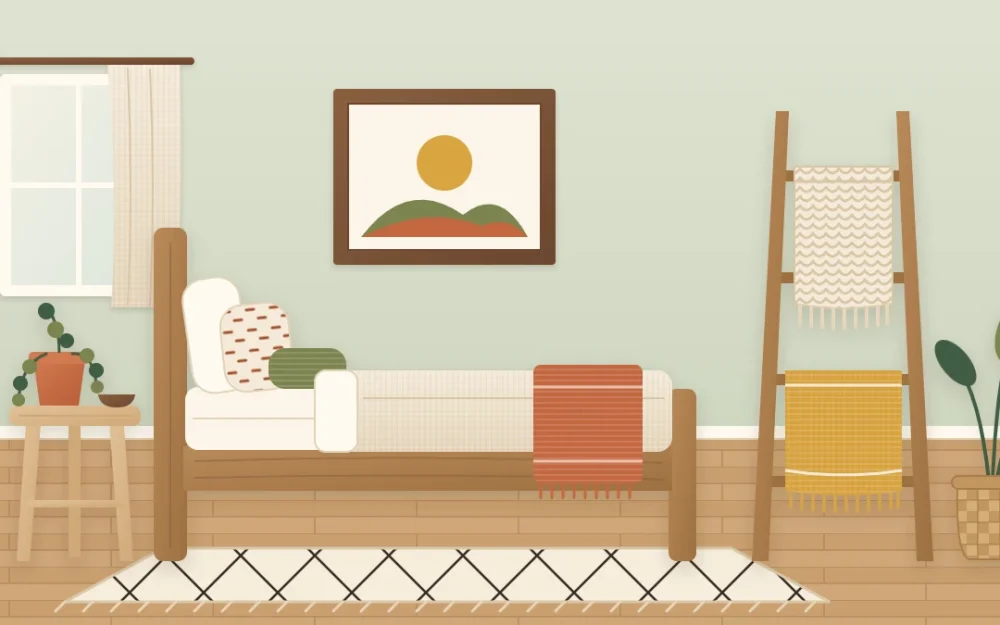
Then allow one or two supporting tones, clearly lighter or darker than the dominant one. A mid-brown bed with a pale stool and a dark picture frame is a reliable trio: light, medium and dark, each easy to tell apart. More than three tones in one bedroom starts to look unplanned, so if you count four or five, move the odd ones to another room.
Match the undertone, not the color
Every wood has an undertone beneath its main color. Warm woods lean yellow, orange or red: honey, golden oak, cherry-like and walnut-like browns. Cool woods lean gray or have an ashy, washed look. Woods of very different depth sit together comfortably when they share an undertone, while two similar browns can argue if one is warm and one is cool.
To read an undertone, hold a sheet of plain white paper against the wood in daylight. Beside the white, a warm wood looks clearly golden or reddish and a cool one looks grayish. Boho palettes are mostly warm, so warm with warm is the easy route. If one piece is cool and you want to keep it, see the fixes below.
Common problems and how to fix them
One piece sticks out
A single dark dresser in a room of pale wood looks stranded. Repeat its tone at least once somewhere else: a dark frame on the opposite wall, a dark wooden bowl on the bedside stool, a tray on a shelf. Two or three echoes spread around the room turn the odd piece into part of a pattern.
Two tones are almost the same
Near-misses are the hardest to live with. Separate them, so they are not side by side, or put something between them: a runner on the dresser top, a basket, a plant. Adding a third, clearly different tone also helps, because it makes the variety look deliberate.
All the wood is on one side
If the bed, bedside table and shelf are grouped on one wall, that side feels heavy and the rest of the room feels unfinished. Carry a small piece of wood across: a frame, a stool beside a chair, a wooden lamp base.
A cool piece in a warm room
Surround a gray-toned piece with things that bridge the gap: cream linen, a clay pot, a jute basket. A painted finish is another option if the piece is yours to change and you are happy to lose the grain.
Small wood accents that do the repeating
You rarely need new furniture to balance wood tones. Small accents repeat a tone just as well, and they are easy to move until the spread looks right.
- A stool as a bedside table or plant stand. A pale stool beside a mid-brown bed is one of the simplest two-tone pairings.
- Frames. One dark or raw wooden frame can echo a larger piece across the room.
- A tray or bowl on a dresser, holding jewelry or a small plant.
- A leaning blanket ladder. It adds height and holds a couple of throws. Follow the maker’s guidance on securing it, and place it where it cannot be knocked over.
Shelves are a good stage for these smaller pieces. The guide to styling bedroom shelves with natural pieces shows how to group them without crowding.
Tip
Stand in the doorway and trace each tone with your eyes. You should be able to find every tone in at least two places, on different sides of the room. If one appears only once, either repeat it or remove it.
Break up the wood with textiles and plants
Wood needs soft, light neighbors to look its best. A rug between a wooden floor and a wooden bed stops the two from merging. Cream bedding against a dark headboard shows off its shape. A linen runner on a dresser, a woven basket beside a stool or a trailing plant on a shelf each put a pause between one wood surface and the next.
The headboard is often the largest piece of wood at eye level, so it is worth choosing with the other tones in mind. The guide to boho headboard options compares wood with rattan, textile and painted alternatives. For how wood sits beside rattan, jute, linen and clay, see the guide to combining natural materials.
Raw, oiled and painted finishes
Finish changes how a wood reads almost as much as its tone does, and mixing finishes adds another layer of interest.
- Raw or unfinished wood is matte, pale and a little rough. It suits stools, ladders, frames and driftwood-style pieces and brings the most relaxed feel.
- Oiled or waxed wood has a soft, low sheen that deepens the color and shows the grain. It suits the larger pieces you touch often, such as a bed frame or a dresser.
- Painted wood swaps grain for color. One painted piece in cream, clay or muted green rests the eye in a room with a lot of brown, and it is a way to keep a piece whose tone fights the others.
Frequently asked questions
Do wood tones have to match in a bedroom?
No. Mixed wood often looks warmer and more personal than a matching set, especially in a boho room. Aim for one dominant tone and one or two supporting tones that are clearly lighter or darker, and repeat each of them at least twice so the mix looks deliberate.
How many wood tones can I mix in one bedroom?
Two or three is a comfortable limit for most bedrooms: one that dominates and one or two that support it. With four or more, it becomes hard to repeat each tone enough for it to look planned, and the room can start to feel like a storage space for unrelated furniture.
How can I tell if a wood has a warm or cool undertone?
Hold a sheet of plain white paper against the wood in daylight. Next to the white, warm woods show yellow, orange or red, while cool woods look gray or ashy. Comparing two pieces side by side also helps, because the difference in undertone is easier to see than to judge alone.