How to Create a Balanced Boho Bedroom That Does Not Feel Cluttered
A doorway check and six problem-and-fix pairs for a boho bedroom that has tipped into visual chaos, plus the order in which to remove things.
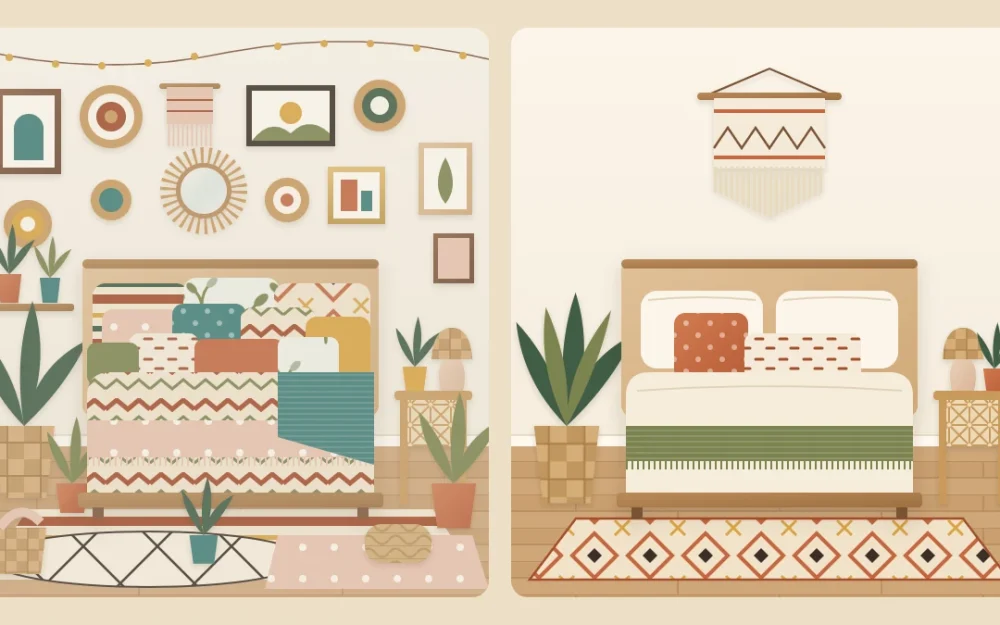
Boho is a generous style, and that is its risk. Every piece you add is attractive on its own, and then one day you open the door and the room looks noisy. Nothing in it is wrong. There is simply no order holding it together.
A balanced boho bedroom is not one with fewer things by default. It is one where busy sits next to calm, each color and material has a partner, and the eye knows where to land first. Below is a doorway check to find what is off, followed by the most common problems and how to fix each one.
Start with the doorway check
You see your bedroom from the doorway more than from anywhere else, so judge it from there. Stand still for a minute and answer these questions honestly.
- Where does your eye go first? Is it one place or several?
- Squint. Does one side of the room look heavier or darker than the other?
- Count the patterns you can see. Are any two touching?
- Pick any color in the room. Can you find it a second time?
- Is there a patch of plain wall, plain bedding or clear floor where your eye can rest?
- Is everything roughly the same height, or is there a mix of tall and low?
Each answer points to one of the problems below. Most crowded rooms have two or three of them at once.
Problem: your eye does not know where to land
What you see: a gallery of small pieces on one wall, a busy shelf on another, a patterned curtain and a bright rug, all asking for attention at the same level.
The fix: choose one focal point and let everything else support it. In a bedroom that is usually the bed wall, because the bed is already the largest thing in the room. Give that wall the strongest piece, a large woven hanging or one big print, and quiet the other walls down to one small item or nothing. If you move or add anything on the wall, choose the fixing for the wall type and the weight of the piece, follow the manufacturer instructions, and keep heavy items away from the area above the pillows.
Problem: pattern is touching pattern
What you see: a patterned quilt against patterned pillows on a patterned rug. The edges of each piece disappear into the next.
The fix: separate every busy surface with a calm one. A plain sheet turned down over a patterned quilt, a solid pillow between two patterned ones, a strip of bare floor between the rug and a patterned basket. Three patterns in one view is a comfortable upper limit for most rooms, and they sit better when they differ in size. The method for combining them is in the guide to mixing patterns by scale.
Problem: one side of the room feels heavy
What you see: the dresser, the tall plant, the floor mirror and the dark basket all on one side, with a single small table on the other.
The fix: spread visual weight from side to side. Weight here means how much attention something takes: large, dark, patterned and tall things are heavy; small, pale and plain things are light. You do not need matching pairs. A tall plant on the left can be answered by a floor lamp on the right, and a dark dresser by a deep-toned throw on the opposite corner of the bed. Tall freestanding pieces and leaning mirrors should go where they cannot be knocked over; follow the maker’s guidance on securing them.
Problem: a color or material appears only once
What you see: one teal pillow, one brass tray, one black frame. Each looks like it wandered in from another room.
The fix: repeat everything at least twice. If rust is on the bed, put it in the rug or a vase across the room as well. If rattan frames the mirror, add a rattan basket or lamp shade. Repetition is what turns a collection of separate things into a scheme. If a color cannot be repeated with what you own, it is the first candidate to leave. Rooms with stronger color need this rule even more, and the ideas for a colorful boho bedroom show how to repeat bold shades with control.
Tip
Repeat across the room, not side by side. Two rust pieces next to each other read as one spot of color. The same two pieces on opposite sides of the room pull the whole space together.
Problem: there is nowhere to rest
What you see: every surface covered edge to edge, every wall holding something, no visible floor near the bed.
The fix: create resting places on purpose. Clear one wall completely. Leave about a third of each tabletop empty as a rule of thumb. Let a band of plain bedding show between the pillows and the folded layer at the foot. Empty space is not a gap you forgot to fill. It is what makes the textured pieces beside it look rich.
Problem: everything sits at one height
What you see: a low bed, low tables, low baskets and a row of small pots, with nothing above waist level except the wall decor.
The fix: put tall next to low. One tall element on each side of the room is usually enough: a floor plant, a floor lamp, a leaning mirror or a tall vase of dried stems on the dresser. On tabletops, group objects in three heights so the outline rises and falls instead of forming a flat line.
What to remove first
When the check shows several problems, do not rearrange everything at once. Remove pieces in this order and look again after each step:
- The smallest objects. Small items create the most visual noise for the least effect. Clear them from every surface.
- The singles. Take out any color or material that appears only once and has no partner.
- The extra patterns. Keep the three you like best and swap the others for solids.
- The duplicate wall pieces. Reduce each wall to one strong idea.
- The surplus pillows and plants. Keep the best few of each and group them.
If the room still feels unsettled after all this, the foundation may be the issue rather than the accessories. Going back to the palette, the bed and the rug in the order set out in the beginner’s guide to boho bedroom decor is often quicker than fixing piece by piece.
Frequently asked questions
Why does my boho bedroom look messy even when it is tidy?
Usually because too many pieces compete at the same level. Several patterns touching, colors that appear only once and walls that each hold many small items all create visual noise. Choosing one focal point, repeating each color twice and leaving some surfaces plain makes the same room read as calm.
How many patterns can a boho bedroom have?
Around three visible from one spot is a comfortable limit for most bedrooms. They work best when they differ in size, share two or three colors and are separated by plain surfaces. If you love more than three, rotate them through the year instead of using them all at once.
Does a balanced room have to be symmetrical?
No. Balance means the two sides of the room take a similar amount of attention, not that they match. A tall plant on one side can be answered by a floor lamp on the other, and a dark dresser by a deep-colored throw. Mismatched bedside tables can look balanced if their heights are close.