Minimal Boho Bedroom Styling: Warm, Edited and Uncluttered
How to get the boho feeling with far fewer things: a three-tone palette, one texture story per surface and a step-by-step edit of the room you already have.
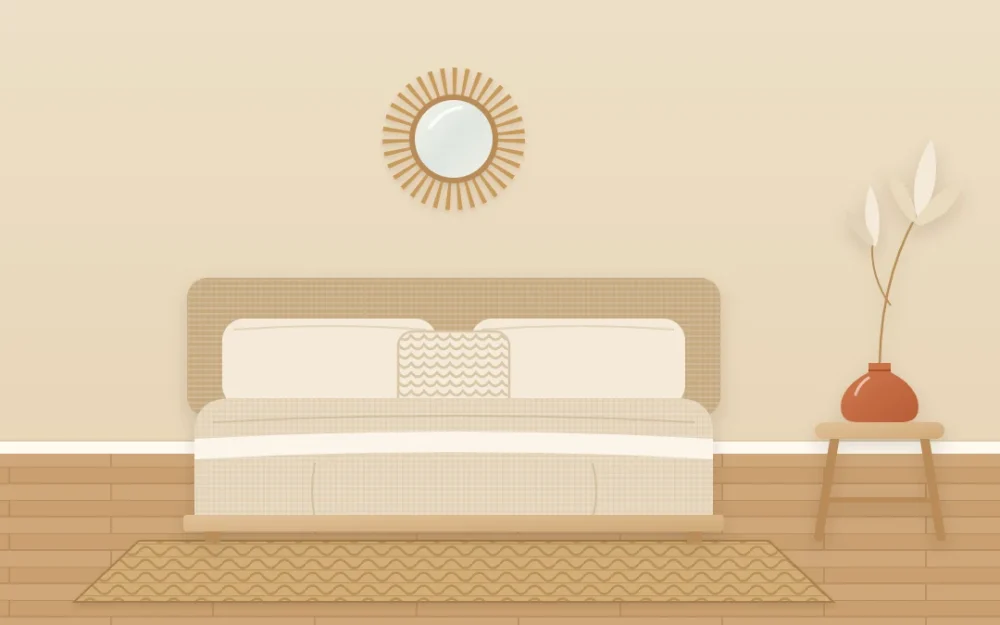
If most boho rooms look like too much to you, the style itself is not the problem. The quantity is. A minimal boho bedroom keeps everything that makes the look warm, the linen, the wood, the rattan, the clay, the wool, and removes most of the objects. What is left is a quiet room where you can actually see each material.
You rarely need to buy anything to get there. This is an editing job, done in one afternoon with the things you already have. The method below clears the room, keeps the pieces with the most texture and puts back about half.
Minimal boho is not plain minimalism
It is worth being clear about the difference, because the two can look similar in a description and very different in a room. Plain minimalism tends toward smooth, cool and uniform: flat white surfaces, sharp edges, little visible texture. Minimal boho is just as uncluttered, but every surface that remains is warm and tactile.
- Color: warm cream, oatmeal and sand instead of bright white and cool gray.
- Surfaces: wrinkled linen, visible wood grain and matte clay instead of gloss and lacquer.
- Shapes: soft and slightly irregular, such as a hand-shaped vase or a round woven mirror frame.
- Finish: relaxed. A bed that looks slept in, not pressed.
If you strip a room and it feels cold, you have reached plain minimalism. The fix is more texture, not more things.
The three-tone palette
Fewer objects means color has nowhere to hide, so keep the palette tight. Three tones is a good working number: a light base, one slightly deeper neighbor of it, and one natural mid tone that usually comes from wood or rattan. Cream, oatmeal and honey-colored wood is one version. Sand, warm white and walnut is another.
Green from a single plant sits on top of any of these without counting as a fourth color. If you want help choosing neighbors that do not look flat together, the ideas for a neutral boho bedroom go deeper into tone.
One texture story per surface
This is the rule that does most of the editing for you. Each surface in the room, the bed, the floor, the bedside table, the dresser top, the main wall, gets one clear texture idea and nothing that competes with it.
- Bed: washed linen bedding, with one textured cushion or one throw as the accent.
- Floor: one rug with a visible weave, such as braided jute or a flat-woven wool-look rug.
- Bedside: a wooden stool or small table holding a lamp and one clay vase.
- Dresser: one group of two or three objects, with the rest of the top left clear.
- Wall: one piece only, with empty wall on both sides of it.
Because each material appears alone, it matters which ones you choose. The guide to natural textures in a boho bedroom describes what each one looks like and what it pairs with.
The edit, step by step
Set aside a couple of hours and have a few boxes or a clear patch of floor in another room ready.
- Clear every surface. Take everything off the bedside tables, dresser, shelves and windowsill. Remove the decorative pillows and throws from the bed, lift small rugs and take down small wall pieces you can remove easily. Leave only furniture, plain bedding and the main rug.
- Look at the empty room. Give it five minutes. Notice which parts already feel calm and which feel bare. This is the baseline you are building from.
- Sort by texture. Lay out everything you removed and pick the pieces with the strongest natural texture: the chunkiest weave, the roughest clay, the most visible grain. Set aside anything shiny, plastic, brightly colored or very small.
- Put back half. From the textured pile, return roughly half to the room, one piece at a time, following the one-story-per-surface rule. Start with the bed, then the bedside, then the wall.
- Add one plant. Choose your healthiest plant with the clearest shape and give it a spot where its outline shows against plain wall. One, not five.
- Stop before it feels finished. When you think the room needs one more thing, wait a few days. It often turns out not to.
Tip
Keep the leftover pieces in a box for a few weeks rather than deciding their fate on the day. Living with the edited room tells you what you miss, which is usually far less than you expect.
Choosing the one wall piece
With a single piece on the wall, scale and placement matter more than usual. A small round rattan-framed mirror or a modest woven piece can sit off-center on a wide wall and look intentional, as long as the wall around it stays empty. A larger textile centered above the bed works too. What does not work is a small piece in the middle of a big wall with nothing to relate to: move it closer to the bed or the bedside table so it belongs to a group.
Before you hang anything
Choose the fixing for your wall type and for the weight of the piece, and follow the manufacturer instructions. Keep anything heavy away from the wall directly above the pillows. A mirror or print leaning on a dresser is a simple alternative that needs no fixing.
Keeping it warm, not empty
An edited room can tip into feeling unfinished. If that happens, check these before you bring objects back:
- Is there enough wood? A stool, a frame or a tray in a warm wood tone adds a great deal without adding clutter.
- Is the bedding too smooth? Swap one crisp layer for something washed, waffled or tufted.
- Is the light too white? A warm bulb in a plug-in lamp with a linen or woven shade softens every surface in the room.
- Is anything repeated? Each material should appear at least twice, such as rattan in the mirror frame and again in a basket.
That last point is about balance rather than quantity. Spreading visual weight from side to side, and pairing each calm area with a small point of interest, is covered in the guide to creating a balanced boho bedroom.
Staying minimal over time
The simplest habit is one in, one out. When a new cushion, vase or print arrives, something of the same kind leaves the room. Clear the bedside table and dresser back to their few pieces once a week, and the room will stay close to the way it looked on the day you edited it.
Frequently asked questions
How is minimal boho different from minimalism?
Both are uncluttered, but minimal boho relies on warm colors and tactile natural materials such as wrinkled linen, visible wood grain, rattan and matte clay. Plain minimalism often uses smoother, cooler and more uniform surfaces. If an edited room feels cold, adding texture rather than more objects usually brings the boho warmth back.
How many decorative items should a minimal boho bedroom have?
There is no fixed number, but a useful guide is one clear idea per surface: one accent on the bed, one rug, one wall piece, one plant, and two or three objects on each table or dresser. If you can list every decorative piece from memory, the amount is probably about right.
Can a minimal boho bedroom include pattern?
Yes, in a small dose. One quietly patterned piece, such as a rug with a tone-on-tone weave or a single cushion with a simple stripe, adds interest without making the room busy. Keep the pattern within your three palette tones so it reads as texture rather than as a new color.